When it comes to the mechanics of wonder, Es Devlin is the long-reigning queen. She has spent the past three decades designing legendary stadium tours, staging some of fashion’s most memorable runway shows and immersing audiences in alternative universes from the opera house to the sports stadium.
There was the unforgettable closing ceremony of the London 2012 Olympics, a love letter to British creativity watched by more than a billion people. More recently came Beyoncé’s Renaissance World Tour, where a gleaming chrome stage, huge kinetic structures and futuristic imagery were the backdrop for one of the defining tours of the decade. And during U2’s opening residency at the Las Vegas Sphere, the venue’s colossal wraparound screen promised to reinvent the live concert entirely. Devlin used the technology to create moments of breathtaking intimacy, collapsing the distance between the band and 18,000 fans. There are Louis Vuitton runway shows that border on performance art, and acclaimed theatre productions including The Lehman Trilogy and The Motive and the Cue, proving that a stage set can be every bit as psychologically revealing as the actors upon it.
It’s perhaps Devlin’s outdoor installations that reveal the truest picture of her imagination as an artist, however. In 2018, Please Feed the Lions turned a version of Trafalgar Square’s famous statue into an AI-powered poet, generating collective verse from words submitted by thousands of passers-by. Three years later, Forest for Change transformed the courtyard of Somerset House into a living woodland containing more than 400 trees, inviting visitors to wander through a temporary forest in the heat of Covid-era London. Public spaces turned into realms of reflection.
Now comes Other Worlds at the Design Museum, the first major UK exhibition dedicated to Devlin’s extraordinary career. For many visitors it will be an introduction to one of Britain’s most influential creative figures, whose name they might not know but whose work they almost certainly will.
Esmerelda “Es” Devlin, 54, was born in south-west London and schooled in Kent before going on to read English literature at Bristol University and study fine art and theatre design at Central Saint Martins. While there, she took an unlikely job working as a magician’s assistant with the experimental circus founded by Jean-Baptiste Thiérrée and Victoria Chaplin, daughter of Charlie Chaplin. Her responsibilities included everything from preparing props to, as she cheerfully recalls, “putting the rabbit in the hat”. More importantly, she learned how illusion really works. “It taught me something really important about magic,” she says. “It destabilises people’s preconceptions. It wrong-foots that habit of looking for what we expect. It creates a sense of wonder and possibility.”
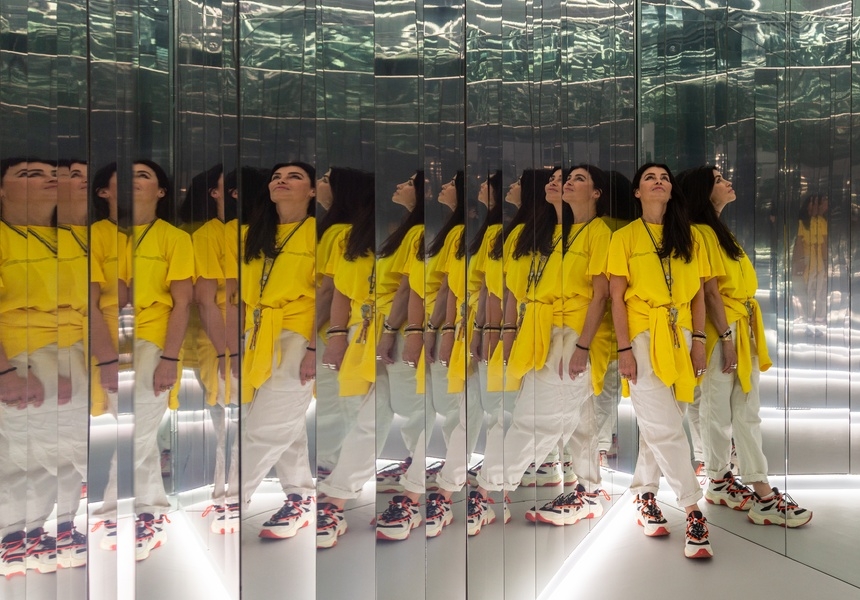
Yet her work never feels like it leans on spectacle for spectacle’s sake. The technology is dazzling, sure, but always in service of an emotional idea. Timing is everything and nature is elevated – if there’s a real-world sunset on the horizon, for example, that will be noted and incorporated, with performance schedules adjusted by minutes accordingly. Her sets breathe, rotate, disappear and transform; mirrors dissolve walls, forests emerge through concrete and audiences become more than just passive onlookers.
The Design Museum exhibition arrives as Devlin’s studio celebrates its 30th anniversary, but Other Worlds is less a retrospective than an invitation inside her mind. “I didn’t want it to just be a catalogue of projects,” she explains. Instead, looking back over the decades has revealed “multiple scenes in one script ... one line of enquiry.”
Alongside a detailed replica of Devlin’s south London studio, filled with books, objects, scale models, sketchbooks, films and immersive installations, the exhibition reveals the research, reading and experimentation that underpin the finished works, allowing visitors to follow her ideas from first spark to finished creation. It has also seen various attempts to categorise Devlin, a harder task than with most creatives. She prefers the term “everythingist”, (borrowed from the expansive aesthetics of Russian avant-garde artist Natalia Goncharova), because, as she puts it: “Maybe the thing is the everything.”
Es Devlin Other Worlds is at the Design Museum from October 2 until April 4, 2027.
This article originally appeared in the fifth issue of Broadsheet London’s magazine.