Skewermania has engulfed London – from yakitori to souvlaki and even Italian arrosticini. Once the domain of Turkish ocakbaşlari, Indian tandoors and longstanding northern-Chinese restaurant Silk Road, skewers have spread citywide.
But skewers haven’t always had the best reputation in Britain. You probably don’t have fond memories of your uncle Johnny’s chicken breast version, scorched to a Richard Ayoade level of dryness, and punctuated on the stick with bulging chunks of raw red onion. Now, chefs cooking across a range of cuisines are rewriting that reputation.
“The main attraction for chefs and even home cooks is the versatility,” says Yahir Gonzalez, the head chef and co-founder of modern Mexican restaurant Zapote. For Isaac McHale, chef-owner of The Clove Club and Bar Valette – which recently served a pork belly and mussel skewer – it comes down to “the age of sharing”. Share plates can be difficult to split, while “skewers stand out because you can just get one [piece] each and you know what’s yours”, he says. “Easy.”
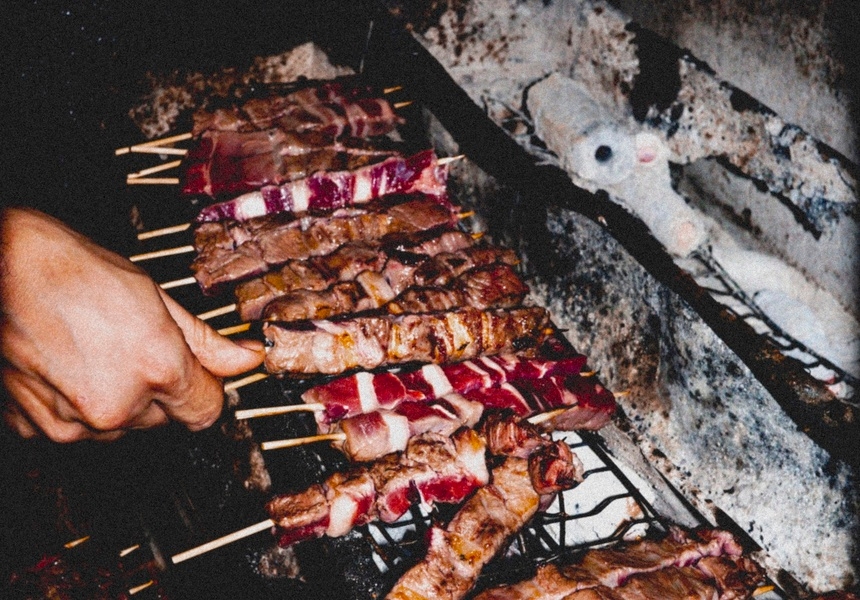
Locating the bellwether skewer is tricky, but contemporary Thai restaurants like Smoking Goat, Kiln and, more recently, Kolae were some of the first to expand the popularity of the format beyond the usual suspects. Even British restaurants like Roe and Sael, French diner 64 Goodge Street and Italian spot Forza Wine are getting in on the act – the latter with variations on mutton skewers from Abruzzo called arrosticini.
For Gonzalez, the skewer is a canvas for experimentation. He notes that it “allows chefs to use every bit of the animal or fish so nothing or very little is left to waste”. David Carter, chef-owner of Borough’s Oma and Agora, agrees, suggesting that the format “lends itself to super interesting combinations”.
For SongSoo Kim, head of sourcing and development at Super 8 restaurants – the group that operates Brat, Mountain, Kiln and Smoking Goat – “part of their current appeal is that they bring that instinctive, elemental act of fire and stick cooking into a contemporary dining setting”. For that reason, they’re “tapping into something primal – a way of cooking and eating that connects directly to our oldest food memories.”
Here are five of London’s best skewers right now, ranging from a skewer tasting menu starring 17 cuts of chicken to Greek-style squid sticks and more.
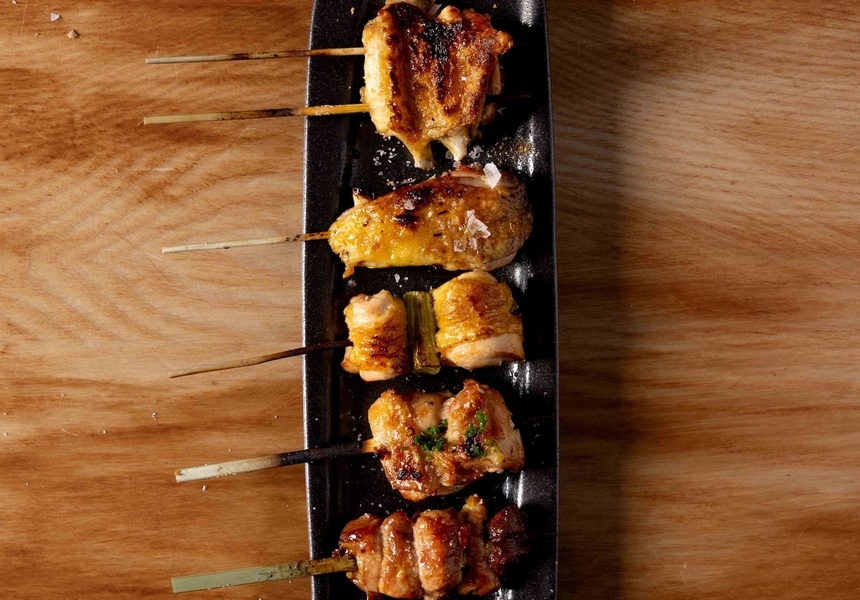
17-cut yakitori at Hotori, City
With its beak-to-tail roots tracing back to 19th-century Japanese street food, “yakitori is like a very OCD approach to roast chicken”, says Kuangyi Wei, co-founder of Hotori. The restaurant offers a 17-cut tasting menu using Fosse Meadows chickens, the quality of which “even our Japanese customers … are consistently surprised by,” Wei says. With meticulous butchery, the restaurant transforms “the tiniest rare parts” of the birds into skewers. The £110 tasting – which includes bonjiri (parson’s nose) and nankotsu (chicken knee cartilage) – must be pre-booked. Shorter four- and six-cut sets – which both include the supremely tender soriresu (chicken oyster) – are always available.
Aged cull yaw cumin skewer at Kiln, Soho
“Thai barbeque is extraordinary, from whole chickens skewered on bamboo to artfully threaded giblets,” says Super 8’s Songsoo Kim, adding that research trips into the “everyday culture of skewers in Thailand … had a lasting, powerful influence” on its menu. London’s modern Thai restaurants now excel at skewers, from the southern-Thai mussel skewers at Kolae in Borough to moo ping – a pork skewer ubiquitous in Thailand – at Smoking Goat. Some of the best known in the capital are Kiln’s cull yaw skewers, where cubes of matured lamb fat intersect with the cumin-dusted meat. It’s like a platonic form of lamb chop in one bite.
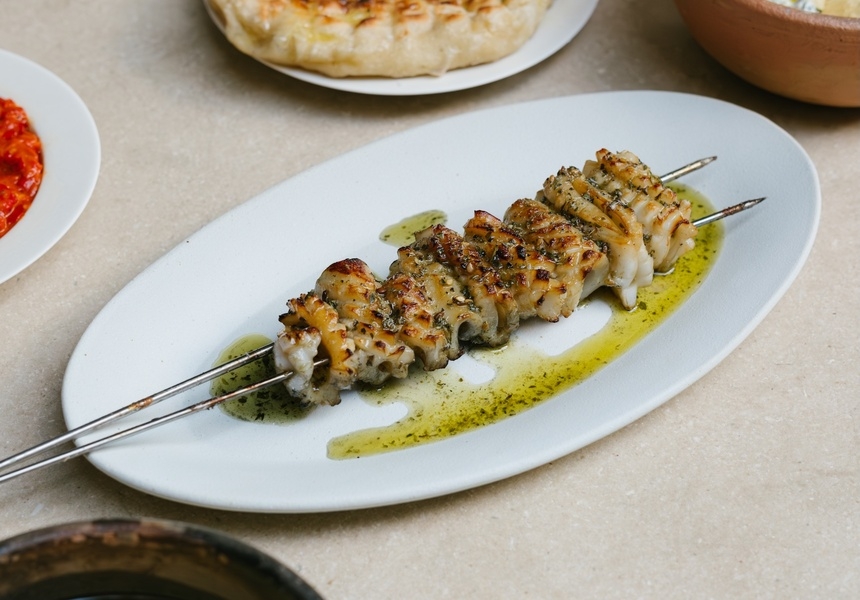
Charred squid skewer at Oma, Borough
Skewers have been central to the success of Agora and its more elevated upstairs counterpart, Oma, which both opened in 2024. Agora is a souvla bar, inspired by “old boys grilling chicken and pork souvlaki in every Saturday street market [in Greece] for a couple euro”, says chef-owner David Carter. Upstairs at Oma, painstakingly scored squid is folded over a skewer to ensure even colouring, caramelisation and soft but smoky bites, demonstrating how the restaurant has built on the souvla’s humble origins. “It’s a much more interesting way of plating the dish,” says Carter. “Albeit tenfold more prep.”
Grilled Suffolk lamb sweetbread skewers at Oren, Dalston
Cosy Middle Eastern restaurant Oren always has a skewer on the menu, and the lamb sweetbreads have been there from day one. “Charcoal-grilled skewers take me back to my childhood,” says chef-owner Oded Oren. “I used to go with my dad to eat onglet, testicles, veal sweetbreads and liver from smoky hole-in-the-wall stalls late into the night. That fire and smoke is what shaped my palate.” The sweetbreads, lightly rubbed with za’atar, emerge subtly smoky from gentle grilling, the meat perfectly juicy.
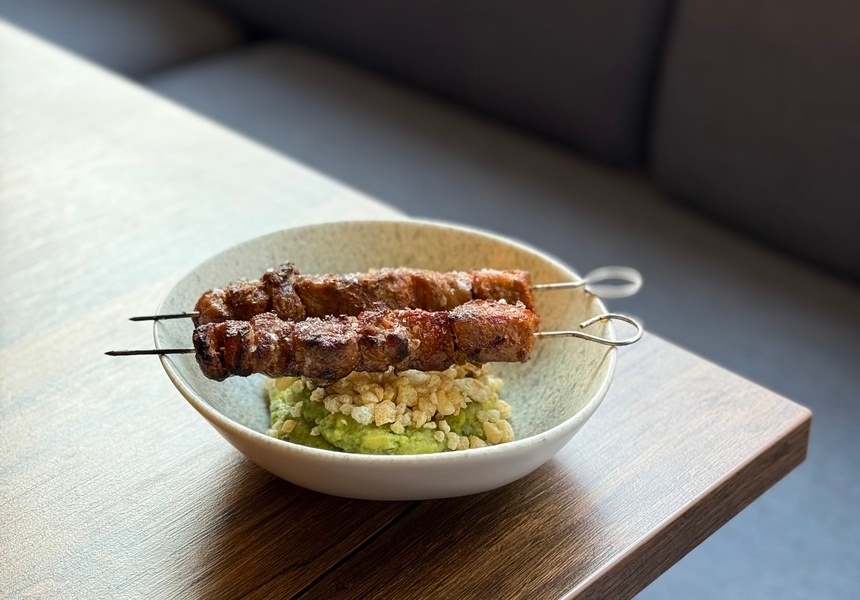
Coal-roasted secreto al pastor skewers at Zapote, Shoreditch
At modern Mexican restaurant Zapote, chef Yahir Gonzalez draws on the Mexican tradition of alambres – cooking meat and vegetables on “wires”. Originating as a “hearty, inexpensive lunch for Mexican construction workers”, they’ve “since evolved into complex tortilla-based dishes … and regional variations swapping meat for seafood”, Gonzalez says. Slow-roasted pineapple and chilli skewers sometimes appear at Zapote as a special, while its chargrilled monkfish skewers include the fish’s livers and cheeks. But it’s the secreto al pastor that remains a mainstay of the menu. Using the highest-quality Iberico pork – cooked until slightly pink to retain its natural moisture – the caramelised skewers are served with pert guacamole and piquant salsa rojo.