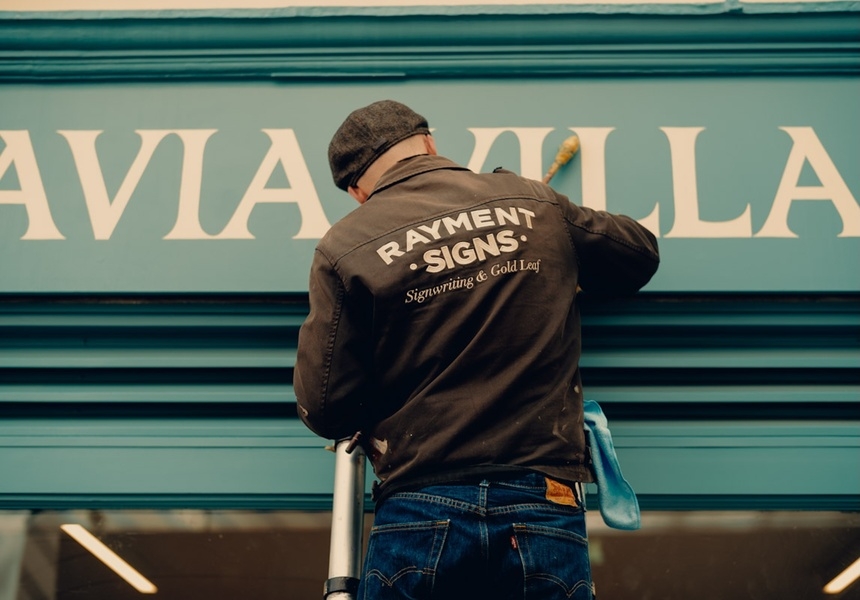
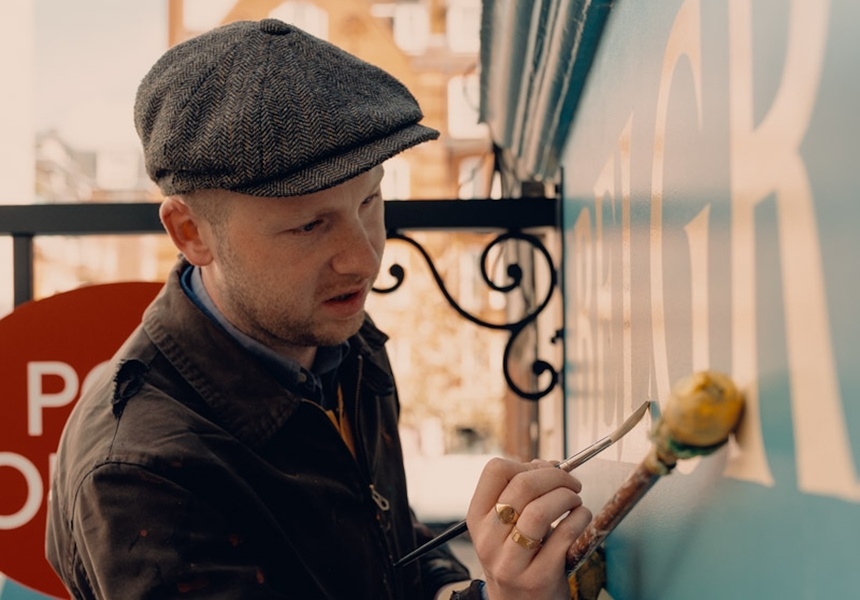
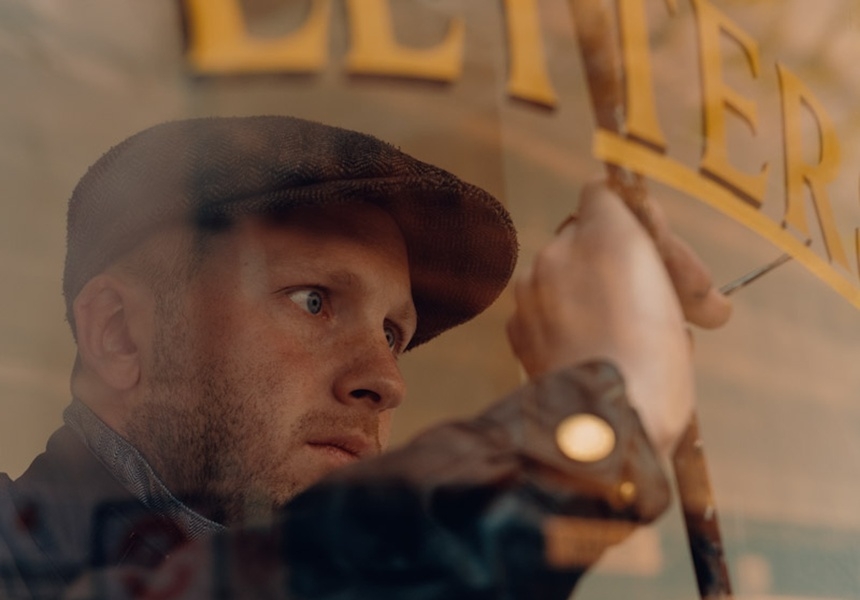
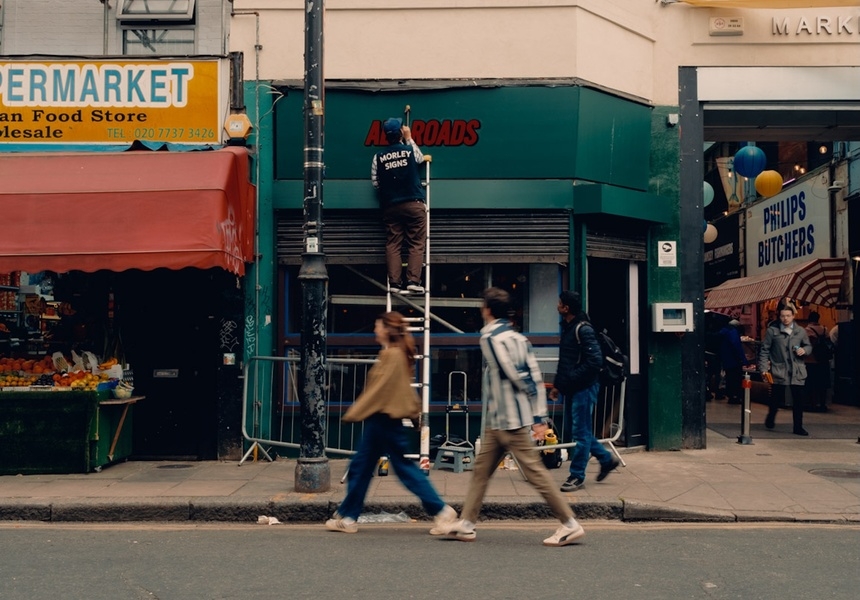
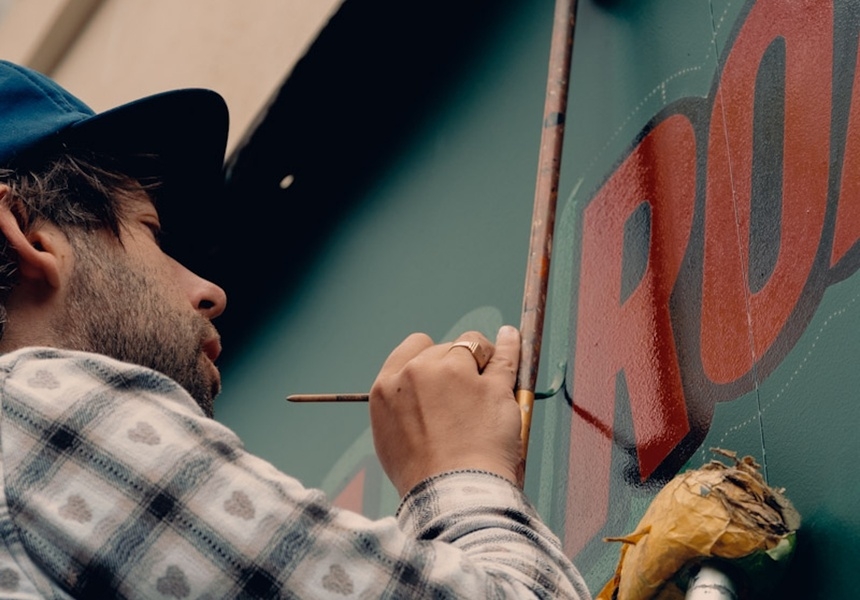
At 12.17pm on a grey afternoon in west London, the gold leaf goes on last. Traffic noses past, someone stops to watch, and, for a moment, everything slows to the pace of a single steady hand. This is the delicate art of signwriting: lettering that sits above shopfronts, swings from pubs and is picked out across cafe windows. There are fewer signwriters working these days – far fewer – yet in the capital demand for the craft is steadily rising.
Nick Morley has just finished work on a pub fascia in Earlsfield. He’s based in London Bridge, but word-of-mouth recommendations and repeat business have inadvertently turned Wandsworth into his patch. “It’s not that you can’t work in someone else’s area,” he says. “It just works out that way.” If he spots a new business opening nearby, he’ll offer his services. “And, more often than not, they’ll go for it.”
Alex Rayment, who learned the craft on a “semi-apprenticeship”, believes the skills required extend well beyond the signs themselves. He’ll research the surrounding buildings on Google Street View and tweak his designs to better blend in. “Are they Victorian? Edwardian? Whatever’s above or on either side, I’ll take that into account,” he says.
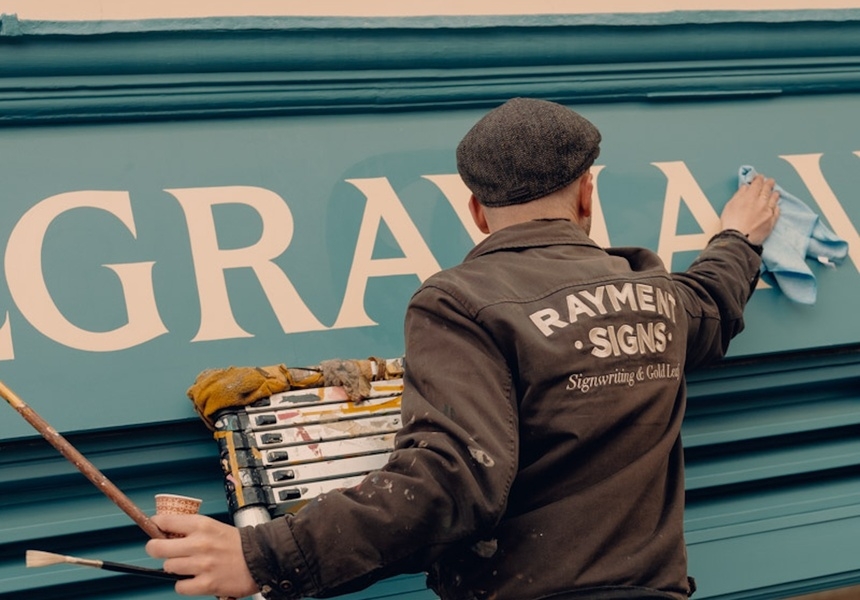
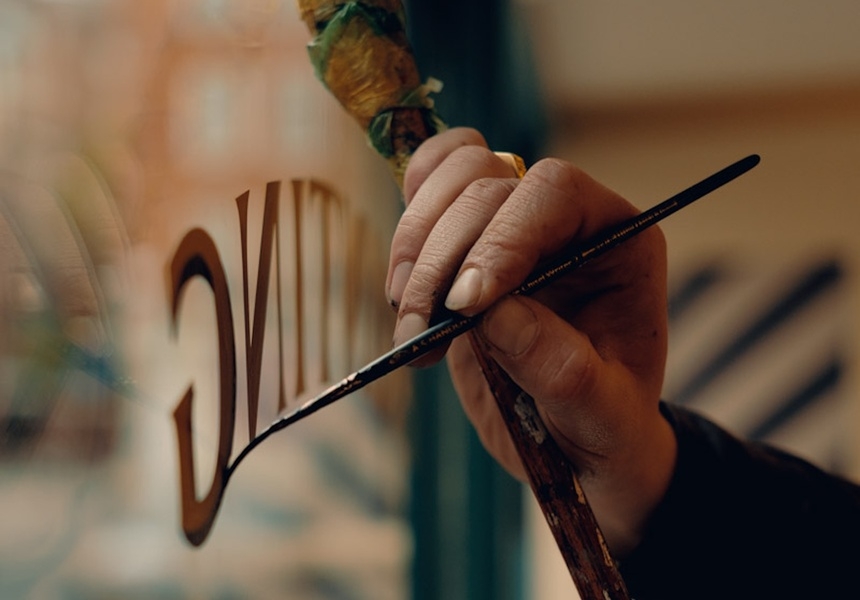
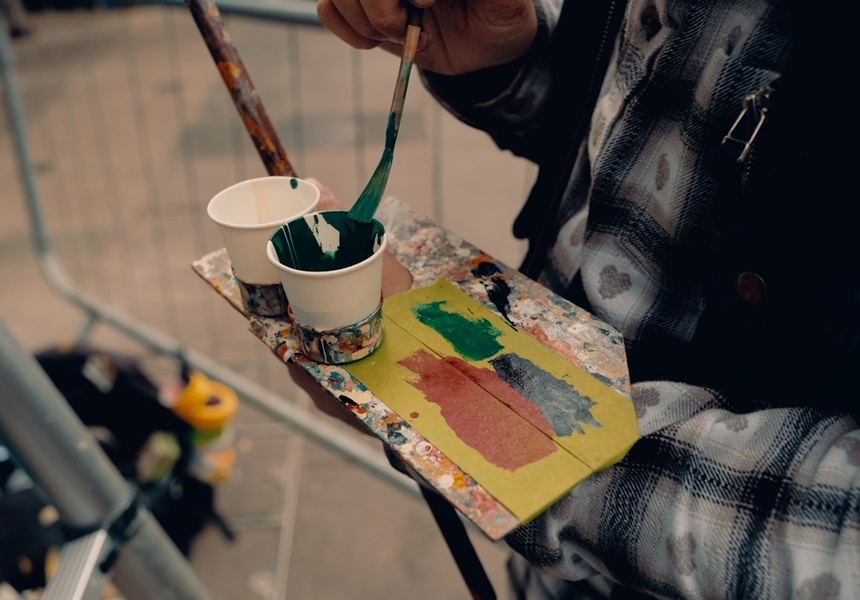
On his best days, Rayment is given creative freedom – and puts every tool in the trusted trolley he takes to work. A nozzle bottle of white spirit sits tucked to one side, an extendable ladder juts from the top, a leather wallet protects his brushes. Like a chef with their knives, he lays them out flat and picks one. “Look, like a chisel,” he says. “It really comes to a point. They’re natural – made from sable or ox hair – and much longer than an artist’s or decorator’s brush.”
The signwriter’s crutch is the mahlstick. Roughly a metre long and capped with a soft bud of sponge or cloth, these steadying sticks ensure every vowel’s sweep, every consonant’s curve holds the line. Rayment is particularly attached to his current one – which is screwable, like a pool cue, with bronze threads – but he admits to mislaying many. “I was on the top deck of a bus once, passing a shopfront I’d done. And there was my old mahlstick, still sitting on top of the sign.”
Hollie Nudds, one of the few female signwriters working in London today, was initially wary of the mahlstick. “It’s such a strange necessity,” she says. “I rejected it at first; tried to teach myself without it. But now it feels like another body part.”
After studying fine art, Nudds started out painting menu boards – an entry point that, like many in the trade, is shaped less by formal training than by improvisation and chance. With no official, standardised routes into signwriting anymore (City & Guilds ran its last dedicated course some 25 years ago), most people find their own way. “And we really help each other,” she says, “because we want to keep the craft alive. We’re solo a lot of the time, which can be quite lonely, so it’s also great to do things with other artists when we get the chance.”
Joshua Harris, a waiter-turned-signwriter, is part of the same small network, where bigger jobs are often shared. He doesn’t consider it a dying art at all. “Maybe that’s because it’s slightly impervious to the AI takeover,” he says. His work is clean and detailed, though he sometimes wonders if, in today’s creative climate, it risks appearing a little too perfect. “Maybe I should introduce more imperfections,” he jokes.
This ability to conjure perfect lettering from nothing is part of why signwriters are still so sought after. “It shows businesses really care about their aesthetic,” says Harris, and owner-operators agree. Joe Grossman, founder of Soho’s Shaston Arms, sees the handpainted sign as a kind of threshold. “It’s the first impression,” he says. “It sets the tone of what you’re about to walk into.” In a landscape of “bigger, louder and newer” branding, he adds, “there’s something magical in a design so painstakingly applied by hand”.
Others point to more practical virtues. Chris Brumby, of Lockdown Bakehouse in Wandsworth, notes that handpainted signs “look even better once they’ve weathered a little. Once vinyl weathers, it’s got to be replaced.” For Mathew Drago-Ferrante, of Holborn’s specialty coffee shop Lamb & Co, it’s about reverence for his shop’s historical surroundings: “Handpainted signs add to the story of Lamb’s Conduit Passage,” he says. “They have a depth and unique character that simply can’t be replicated.”
Harris also cites the environmental benefits of handprinted signs over vinyl, and the relative speed of traditional signwriting, which can bypass the red tape that often slows down more elaborate frontages.
“I’ve also noticed a real uptick in people being inquisitive on the street,” he adds. “We’ve heard the typical quips – ‘Oh, you’ve spelt it wrong!’ – thousands of times. But it’s generally very positive. People usually just remark how nice it is to see an old, traditional craft in practice.”
It is, after all, the most public of art forms. “That’s the best thing about what we do,” Morley says. “It’s for everyone to see. It’s not hidden away in a room where nobody looks at it. Sometimes, we just walk around London together talking and looking at the work we’ve done.”
This article originally appeared in issue 4 of the Broadsheet London magazine. Find a copy here.