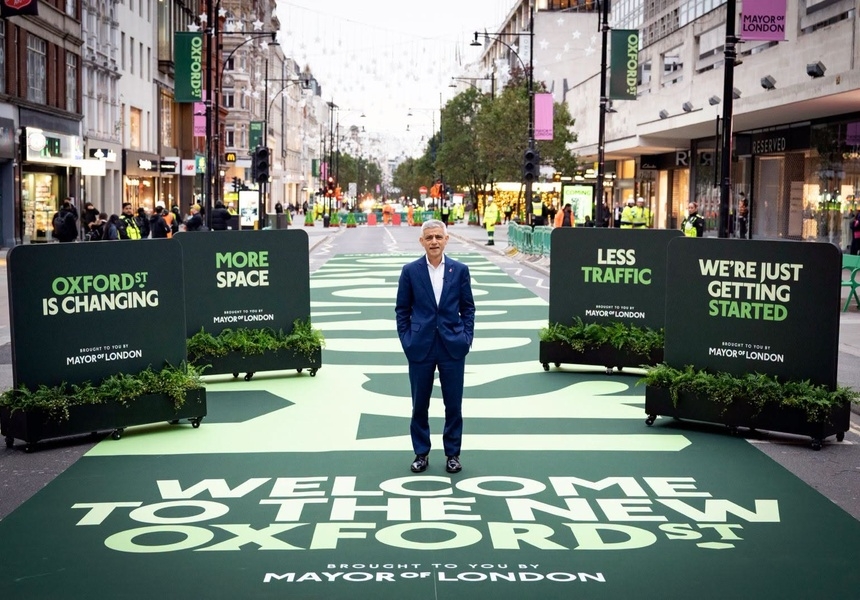
As of 7am this morning, October 26, dodging fellow pedestrians on the busy Oxford Street pavement – while avoiding stepping into a stream of buses, taxis and bikes – is a thing of the past. A stretch of 0.6 miles has been pedestrianised, meaning that all motorised traffic, including buses, black cabs and bicycles, are not able to enter.
Running between Orchard Street and Great Portland Street, encompassing Selfridges and John Lewis, and entrances to Bond Street and Oxford Street stations, the traffic-free section is part of mayor Sadiq Khan’s vision to transform the world-famous high street.
“There has been talk of pedestrianising Oxford Street for decades,” Khan said in a statement. “After so many false dawns, and now working with a government who share the scale of my ambition, I’m proud that we’re finally unlocking a new era for the street.”
In the current first stage of the programme, Londoners can expect minimal construction to ensure that there’s as little disruption to the busy Christmas shopping period as possible. Data and feedback will be collected about how people are using the space, which will then inform further developments; these are expected to include new trees, two new public squares, more than 100 new seats and dining tables and better signage by the end of spring 2027.
To adapt to the pedestrianisation, TfL has diverted and changed some bus routes; there are new bus stops approximately 200 metres from the traffic-free area. There are taxi ranks with 100 metres of the traffic-free area, and mobility scooters are still allowed. Emergency services will still have access to the street at all times.
The transformation of the Oxford Street district – which is twice the size of King’s Cross – has been in the works for over a decade. Mayor Khan had the pedestrianisation project in his 2016 manifesto, but this was rejected in 2018 by the then-Conservative Westminster Council. In September 2024, Khan announced plans for wider transformation of the area, and in a public consultation that followed in early 2025, 66 per cent of respondents supported making Oxford Street traffic-free. In February this year, Khan announced that the project would go ahead.
Khan hopes that the pedestrianisation project will herald a new era for the district; one with more high-quality retailers (and fewer of the ubiquitous American candy shops), workplaces and dining. “And we’ll bring new experiences to the street, from sport to fashion and cultural events,” he said. “Revitalising Oxford Street will … unlock the full potential of this key part of the West End.”