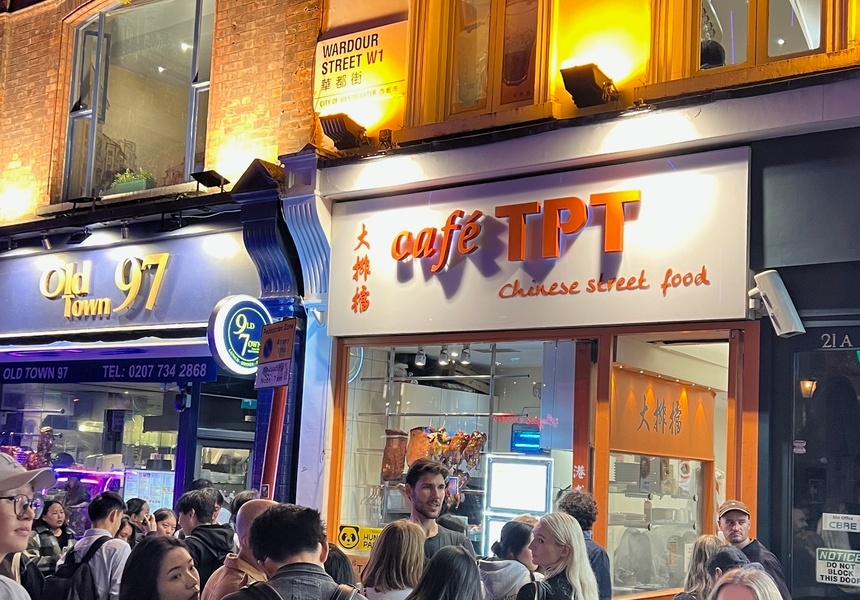
At 61, Rex Yip has considerably more spring in his step than his similarly aged peers. “Even when I reach 67, the official retirement age, I’d still be working until I physically can’t cope,” he tells Broadsheet. When he opened Cafe TPT, the legendary Cantonese restaurant in the West End’s Chinatown 23 years ago, he was a sprightly 38-year-old with a plan and no lack of energy.
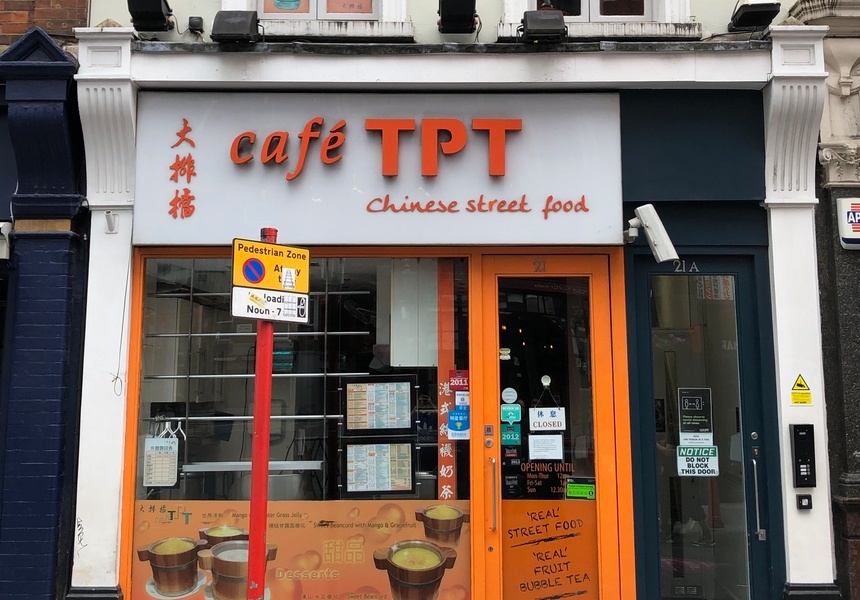
Despite the wear of operating a one of Chinatown’s most successful restaurants, on one of the city’s busiest corners for more than two decades, he still outworks many of his younger colleagues, and is a familiar face to regulars. So when Cafe TPT recently announced on Instagram that the restaurant would close on October 27, it was a shock to longtime customers who had become accustomed to Yip’s calming presence and TPT’s familiar orange-and-white frontage on Wardour Street.
The business’s imminent closure (it was approached with an offer on the site) marks the departure of another of Chinatown’s classic restaurants, and the last of the cafe-style spots serving quick, casual meals at an accessible price point that defined much of the area’s offering of the 2000s and 2010s.
Cafe TPT opened in 2003 on the former site of Luk Yu, “a very traditional old Chinese restaurant”, Yip says. “When we took over, the cafe era was quite popular, so we adapted to that and aimed more at younger customers and students.”
The restaurant was one of a handful that became popular for their delicious, inexpensive meals that were accessible to both homesick Hong Kongers and students drawn to the area and neighbouring Soho for its then-numerous arcades and entertainment venues. The cooking that TPT and its now-closed contemporaries like HK Diner, Cafe de HK and Hung’s offered was reminiscent of Hong Kong’s dai pai dongs, open-air restaurants that serve dishes intended to be prepared and eaten quickly, like noodle soups, claypot dishes, seafood, and stir-fries tossed speedily in blazing hot woks.
Despite opening to the twin headwinds of the Sars outbreak and the Iraq war’s economic downturn, Cafe TPT found early success with staples like siu mei (Cantonese roast meats), siu yuk (crispy pork belly), siu aap (roast duck) and char siu (barbecued pork) laid over vegetables and rice, then – and still – an ascetic and almost meditative antidote to a city enamoured with superlatives and firsts.
“The start wasn’t good,” Yip recalls. “But slowly we built our reputation and found stronger footing in Chinatown.”
It would be three more years until the now-seminal Barshu and its bold Sichuan cooking arrived a few steps away on Frith Street, and almost another 10 before Shaanxi-style cuisine intoxicated the city with its heady blend of vinegar, chilli and cumin. The city’s shift toward regional cooking was clocked by Yip. “As time went on, we could see the market changing,” he says. “At first the main offering was a small selection of roast meat on rice, and then we introduced more regional popular dishes.”
The restaurant’s imminent closure hasn’t gone unnoticed by longtime regulars and millennials old enough to remember a different Chinatown. “Cafe TPT is about comfort food,” says Susanna Lau, writer and co-founder of Dot Dot Tea. “It’s familiar Cantonese flavours for me and sort of has a dai pai dong feel with the squished seating and not-fancy interiors.
“They were one of the few places that would do steamed chicken, shiitake mushroom, black fungus and Chinese sausage – a dish that really is classic home-cooked Chinese – something my mum would make all the time.”
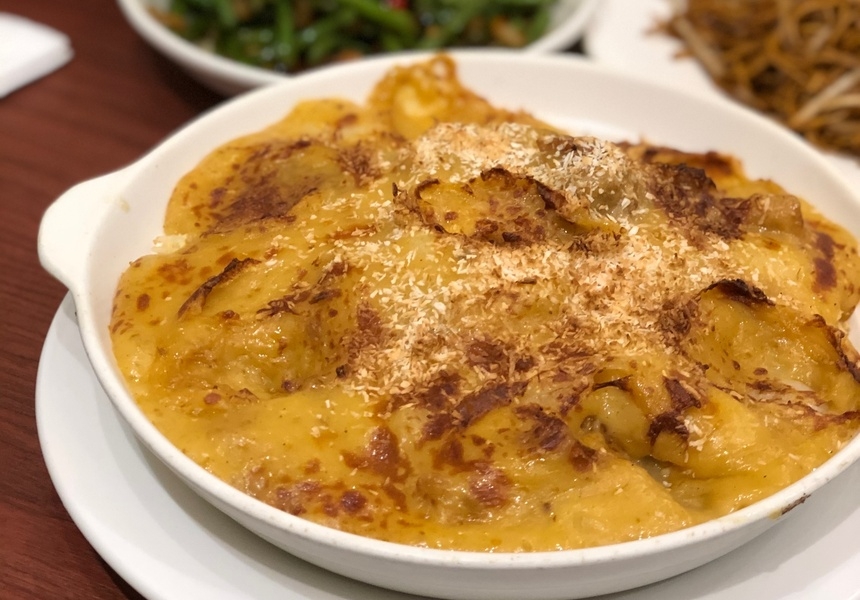
Lau and Yip both note the Macau-style baked pork chop rice in bechamel as a dish that’s still going strong, as does Angela Hui, author of Takeaway (and Broadsheet contributor). “It melts into a single entity that’s probably best described as comatose comfort,” she says. The restaurant’s Malaysian-style laksa has also earned a cult following, as has a previously off-menu beef flank curry that ranks among the city’s outstanding curry-style dishes.
Once TPT shutters, the sense that a chapter of Chinatown’s history is coming to a close feels difficult to shake. Though old-timers like Old Town 97, Lido and Wong Kei still stand, the neighbourhood has undergone as much change as any in the city.
“As a Hong Konger, I definitely grieve the nostalgic element because somewhere that’s been representing Cantonese food for 20 years [is going to close down],” says curator Elaine Zhao. “And I think for all Hong Kongers, because our hometown has changed so much, anything that’s an erasure of a classic Hong Kong experience feels sad because we’re constantly having to move forward and be okay with change now.”
“It’s tough also when Hong Kong food is being repackaged in more contemporary and more ‘’grammable’ surroundings, with places like The Eight and cafe Hoko,” Lau says. “Chinatown nowadays seems to feel like a theme park competition to attract eyeballs and queues, and maybe it’s less about the food and more about the aesthetic contextualisation of the food, which is a shame.”
“The younger generation is more social media-driven,” Yip echoes. “They want something new and trendy, and whenever something new comes into the market they like to be part of it, capturing that taste. There’s nothing wrong with that. It doesn’t mean they don’t eat regular meals, but the emphasis is on something new.”
But in more ways than one, Hoko and The Eight’s adaptation to the modern zeitgeist for contemporary Asian cafes and aesthetics doesn’t feel dissimilar from the owners’ original decision to mould Cafe TPT’s approach to the trend for casual eateries in the early 2000s. The permanent shuttering of classic restaurants like TPT or Hung’s follows a now-familiar story of unaffordable rents or a family business that fulfilled its purpose – to shuttle the next generation to an easier, less physically demanding life.
And while there are businesses like Golden Phoenix and Tao Tao Ju that are being shepherded by a new generation, the decision to choose a life in restaurants is exactly that – the privilege of choice that an earlier wave of immigrants worked for their descendants to have.
Yip himself briefly mentions his own family. “They’re not interested in restaurants – they’re both professionals with their own careers,” he says. “It’s fun, but it’s time-consuming. You really lock yourself in. You’re either in or out, and you can’t do it in between.”
Cafe TPT closes on October 27.