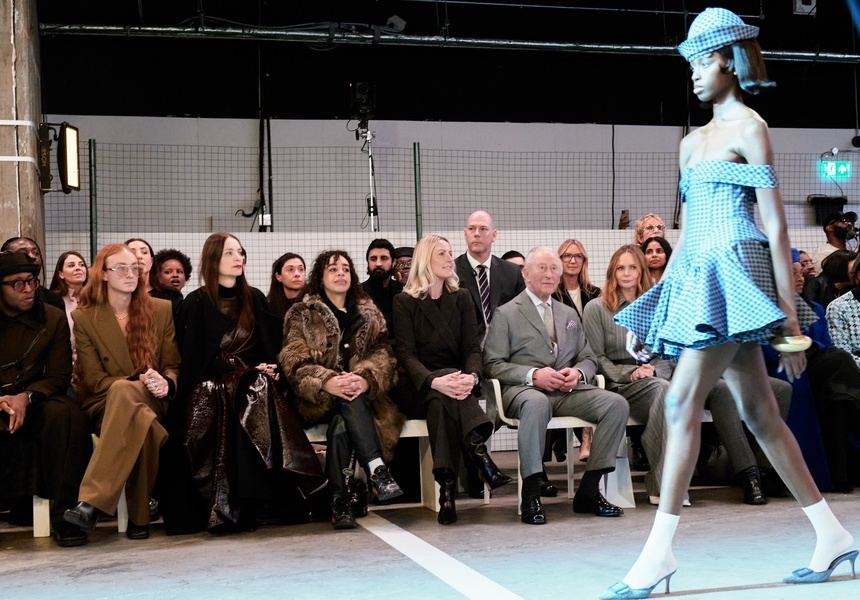
We’ve always been known as both the plucky fashion underdog and the destination for radical creativity, home to era-defining visionaries from Vivienne Westwood and John Galliano to Jonathan Anderson and Erdem Moralıoğlu. And there is palpable excitement in the air once more as London Fashion Week kicks into action this month, particularly about returning heavyweights such as McGirr’s Alexander McQueen and Christopher Kane in his much-anticipated debut as creative director at Mulberry. “Sometimes in the past London has been skipped by the international crowd,” says front-row fixture Ida Petersson, a talent mentor and co-founder of creative agency Good Eggs. “That won’t be the case this season. There’s another wave of energy coming.” This uptick in billboard names, alongside the heritage halo effect of Burberry’s presence, attracts the all-important buyers and editors. “They’re absolutely key to international footfall,” says Petersson.
Although London’s reputation as a talent incubator has never been in doubt, many of the emerging labels lacked the financial resources and business acumen to scale up and take their work to the next level. A redistribution of British Fashion Council funding, led by CEO Laura Weir, has changed the game.
“She’s made huge changes,” explains designer Patrick McDowell, last year’s recipient of the prestigious Queen Elizabeth II Award for British Design, whose sustainably made creations have been worn by the likes of Lady Gaga and Sarah Jessica Parker. “There’s been renewed focus on designers. This year, my business was named a BFC Fashion Trust recipient, a grant which enables you to do something that you wouldn’t be able to do before. There’s more funding, but Laura has also helped connect brands with partners for catwalk shows and collaborations. Every little really does help when you’re running an independent label.”
A rise in mentoring schemes has also given visibility, guidance and business-building skills to blossoming brands. Paul Smith’s Foundation has helped nurture some of 2026’s most exciting design talents, including Pauline Dujancourt, Yaku, Karoline Vitto and Paolo Carzana. The Hugh Devlin Foundation, launched in June, offers pro-bono legal and financial advice, an invaluable service for young independents. “Anyone can launch a brand, but it’s much harder to sustain it. London has more of an open-door policy than other cities,” says Daisy Hoppen, founder of influential PR agency DHPR, which represents clients such as Craig Green, Rejina Pyo and Ganni. “The support out there is really helping.”
London’s designers have always had boundary-pushing ideas; what’s changed is their execution and commercial viability. Bold concepts mean little unless they can be translated into clothes that spark desire. A renewed dedication to quality, technique and craftsmanship is the uniting thread among the buzziest new generation of designers. McDowell has been hailed for beautifully crafted feminine looks made using upcycled materials. Standing Ground, helmed by Irish designer Michael Stewart, achieved a major coup when it was invited to show at Paris’s Couture Fashion Week in July, a rare British outlier among the schedule’s luxury titans. Steve O Smith is attracting attention for transforming his paper drawings into wearable art. Newcomer Goyagoma, by former Phoebe Philo trainee Traiceline Pratt and part of the Fashion East incubator, “had jaws on the floor” at its spring LFW show, according to Petersson. “The finish and the craftsmanship was just, wow. It reminded me of a very cool, old-school Celine.”
It isn’t just the London catwalk labels driving momentum. After her sorely missed label The Vampire’s Wife shuttered in 2024, Susie Cave returned to fashion in June with new business Weddings and Funerals, opening an appointment-only boutique in Kensington dedicated to demi-couture occasion-wear. Even pre-launch, the demand was so high that bookings stretched well into October. Dover Street Market, a cultural platform as much as a department store, now has outposts all over the world, most recently arriving in Paris.
On the other end of the spectrum, cult store Jake’s in Bethnal Green has become a go-to destination for the capital’s most stylish menswear shoppers. Inspired by Tracey Emin and Sarah Lucas’s short-lived ’90s retail space, The Shop (also in Bethnal Green), the gallery-style space stocks one-off and limited-edition pieces that founder Jake Burt makes each week, often from upcycled materials. It opens only on Saturdays and swiftly sells out. “If you look at that queue, it’s a who’s who of the cool crowd,” Petersson says. “My friends are obsessed with when the next drop is coming.” It’s a prime example, she adds, of how “the new fashion guard is able to present themselves in [whatever] way they want to”.
That’s not to say that London isn’t facing its challenges. Everyone I spoke to for this piece cited Brexit and the loss of free-trade movement as an ever-present roadblock. Data from the UK Fashion and Textile Association shows that our fashion exports have fallen 65 per cent, from £4.76 billion in 2016 to £1.67 billion in 2025, and the scrapping of VAT-free shopping for international visitors has made London less attractive for luxury retail tourism compared to Paris or Milan.
“I’m pretty sure most of us are feeling how tough it is out there right now,” says designer Priya Ahluwalia, recipient of the 2021 QEII award. “But moments like these can breed creativity. They force you to take a look at how you’re approaching your work and can actually lead to more innovative ideas.”
McDowell agrees. “Considering the annual global disasters that seem to keep happening, there’s a certain resilience to this city,” they say, drily. “And often during difficult times creatives respond through even more beautiful and well-made clothes, which is what we’re seeing.”
London Fashion Week runs from September 17 to 21.