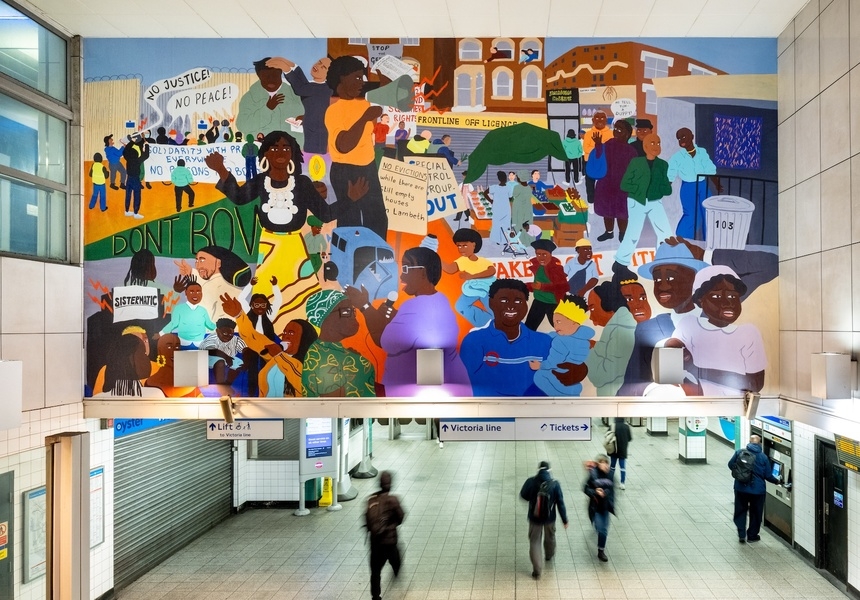
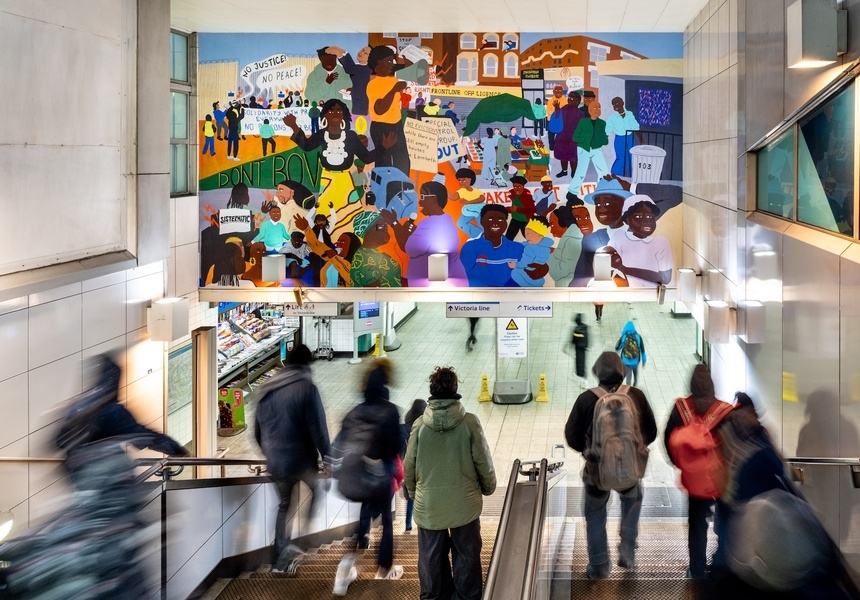
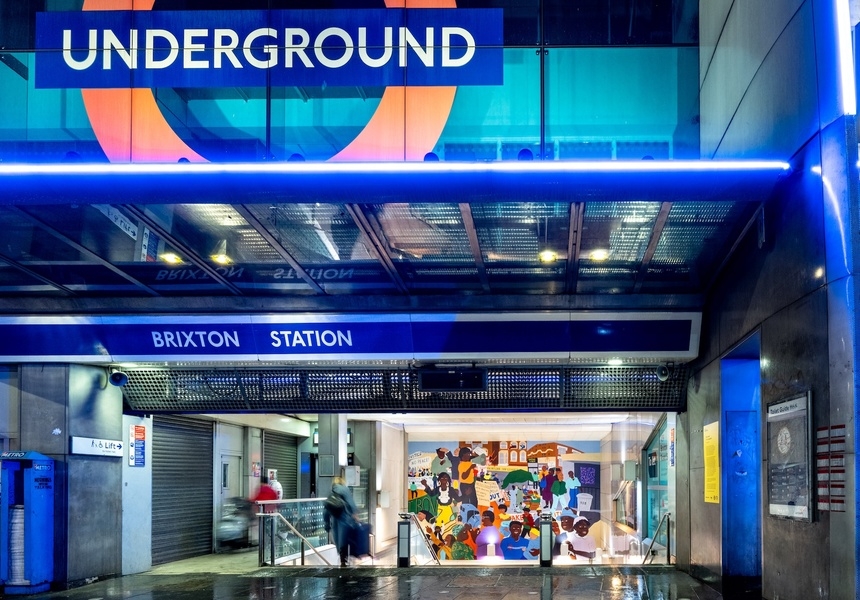
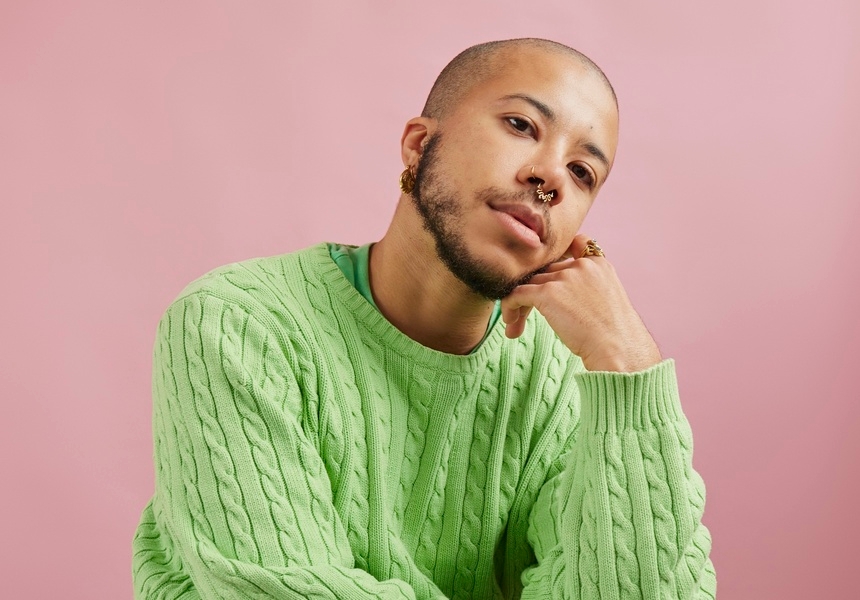
A 10-metre mural by London-based artist Rudy Loewe has just been unveiled at Brixton Underground Station, depicting the area’s rich history of activism, community activity and social life. It’s the ninth mural to be commissioned for Brixton Tube station, continuing a tradition of local mural-painting dating back to the ’80s – and is part of the 25th anniversary celebration for Transport for London’s Art on the Underground programme.
“When you’re getting off the bus or the tube [in Brixton], it’s loud, there’s music, there’s colour, there’s preachers,” Loewe tells Broadsheet. “It felt important to try and capture some of that. It’s sensorily a rich place, one that feels very Caribbean. I hope that, whether or not people see their Brixton, [they see] glimmers of different layers of Brixton.”
The Congregation weaves together 20 vignettes that each depict layers of Brixton’s legacy: the arrival of the Windrush Generation in Brixton in the ’40s; aunties shopping in Brixton Market; dancefloor scenes from nights run by Sistermatic, a Black lesbian-run sound system; the noise demonstrations that take place annually outside HM Prison Brixton every New Year’s Eve.
Alongside individuals and communities, there are also enduring landmarks that have shaped the area, such as the 121 Centre on Railton Road, one of the UK’s longest-running squats, the underground gay bar that Pearl Alcock ran from her flat in the ’90s for Black men, and the storefront of Atlantic Road’s “Frontline” off license, which was the site where resistance began during the 1981 Brixton Uprising.
Blending historic uprisings with scenes of joy and grief with day-to-day mundanities, The Congregation is a tableau of complexity – and for Loewe, this is an accurate reflection of Brixton, where they once lived and have spent much of their time.
“When I got the commission, I wanted to find a way to tell different stories of Brixton,” Loewe says. “I was trying to find people in Brixton who would want to be a part of the work and there were people I specifically reached out to.”
Amongst the dynamic blended scenes, there are two individuals and a pair that Loewe sat down with as part of their research. There’s Marcia Rigg, whose brother, Sean Rigg, died in police custody during a mental health crisis at Brixton station in 2008, and has since become a leading political activist and campaigner on the state of policing in the UK.
She’s joined by Yvonne Taylor and Eddie Lockhart, founders of Sistermatic which created a crucial space for Black queer women, and CJ Rivers, a TfL train operator. For Loewe, Rivers’ inclusion ties back to the Windrush generation: “A lot of them have worked for TfL and I wanted to make that full-circle reference on how important that generation of Caribbean people have been in TfL, but how it has also laid the ground for more Black people working in TfL now and that lineage is continuing.”
Loewe’s artistic practice is guided by archival research, weaving in African and Caribbean folklore – and in creating The Congregation, they delved into the Lambeth Archives and TfL Archives.
“I hope [seeing the mural] encourages people to do some research for themselves in the community,” Loewe says. “I would love for people to feel like they could research in those spaces.”