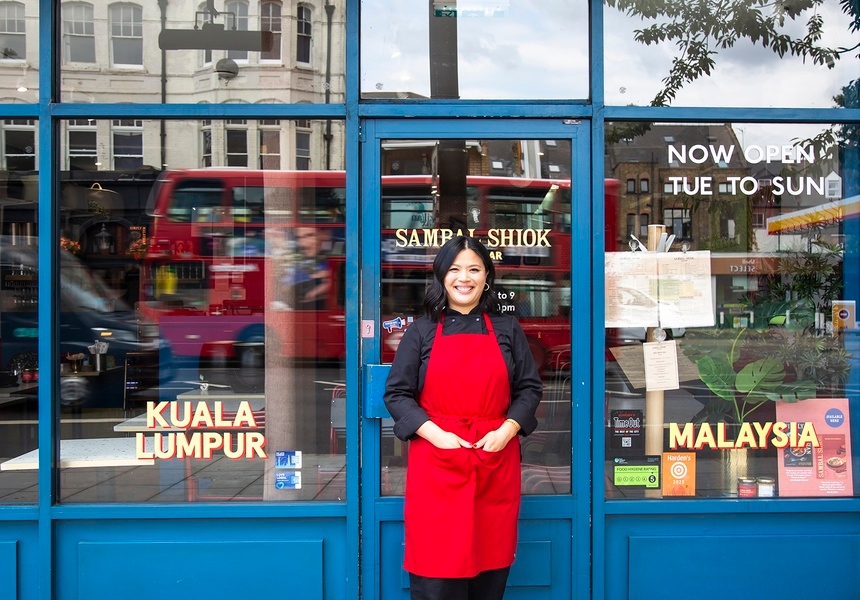
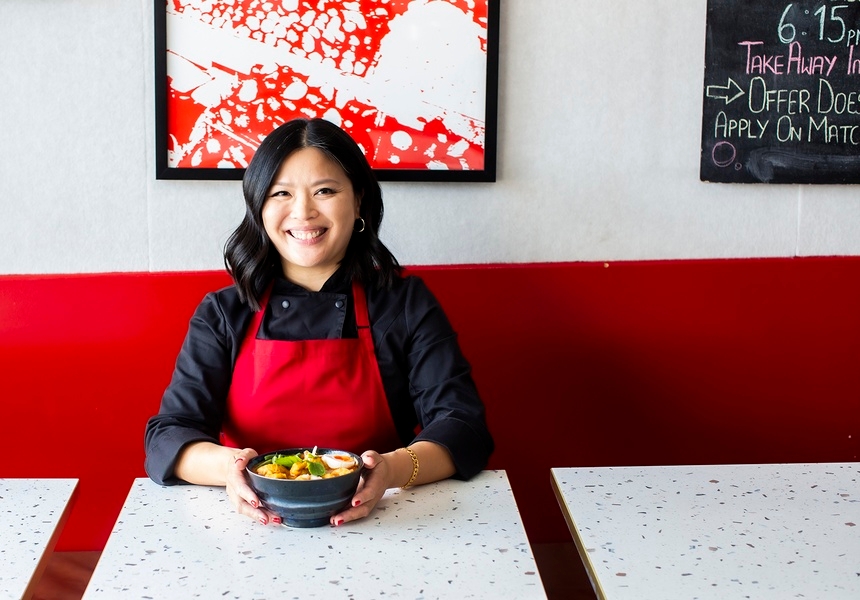
Last week, Sambal Shiok owner Mandy Yin announced the closure of her Highbury restaurant on Instagram. “I cannot continue personally carrying the financial risk or injecting funds to keep the business afloat,” she wrote. “Relentless cost increases, staffing pressures and the weight of operational responsibility have taken a deep toll on my mental health and personal life.”
In so many ways, Sambal Shiok’s rise and its subsequent challenges have mirrored London's shifting restaurant landscape over the past decade. Few could have foreseen the wave she would ride since launching her concept 13 years ago. “The restaurant was an outlet to be my whole self,” Yin tells Broadsheet. “Malaysian, loud and proud, no apology and no watering down for an unfamiliar palate. Not many jobs let you do that.”
Though her Holloway Road restaurant opened in 2018, Yin had been making a name for herself and her concept – named for the Malaysian condiment and a Singlish exclamation of quality – on London’s street food circuit since 2013. Later, a series of pop-ups cemented her place in a London hospitality landscape that had developed a newfound swagger and verve, before she finally opened the restaurant proper. This early success dovetailed with London’s newfound embrace of small-scale operators working from food trucks and temporary spaces – think Kerb and Street Feast, which both launched in 2012.
That foundational phase, which was fuelled by the breakout popularity of Yin’s satay chicken burger, also leveraged the growing popularity of Instagram as a discovery tool, feeding Londoners’ growing obsession with dining out. At the same time, other independent operators with similarly snappy concepts, like Bao and Smokestak, began capturing public imagination. Each would open critically acclaimed restaurants that would shape the city’s tastes and dining habits for years to come.
When Yin finally opened her restaurant, it felt momentous. “Sambal Shiok represented a defining moment in London’s food scene, when some of the city’s most exciting street food traders were making the leap into permanent restaurants,” says Clerkenwell Boy, a friend and supporter of Yin’s from the restaurant’s early days.
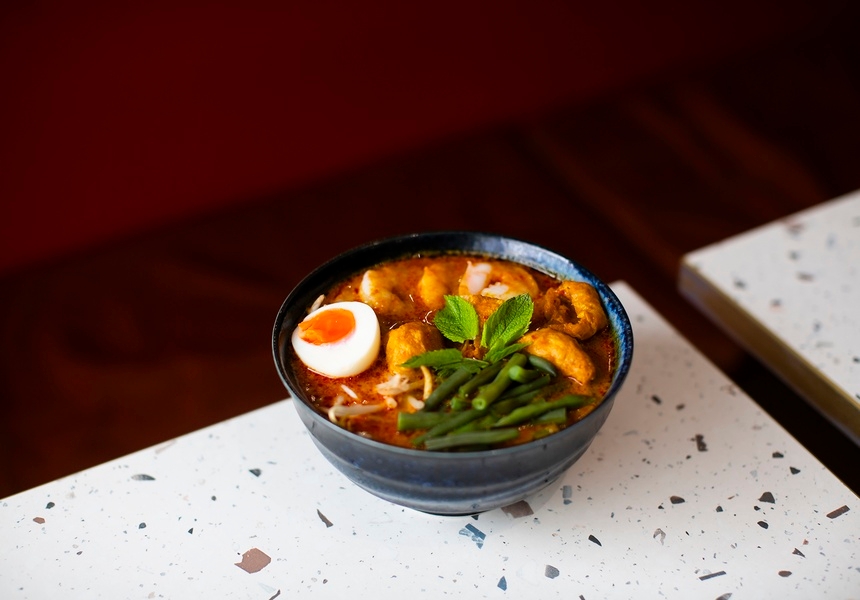
The restaurant received wide acclaim, thanks to its uncompromising, chilli-heat forward bowls of curry laksa (with the laksa paste and broth made from scratch) sitting alongside shareable small plates like the chef’s take on fried chicken and gado-gado salad. Desserts featured ingredients like pandan and rose syrup, which were relatively uncommon at the time.
Sambal Shiok was also instrumental in introducing non-Malaysian Londoners to regional dishes like assam laksa and seasonal traditions like the restaurant’s annual yee sang (prosperity salad toss) during Lunar New Year.
“Look at the number of laksa-led restaurants in the city today,” Yin says. “We were part of moving Malaysian food from ‘what's that?’ to something Londoners feel protective of.”
But over the past several years, the game has become tougher. The uphill battle that the restaurant industry faced during Covid felt insurmountable, but it was only the first of a series of global events that have roiled the sector. Successive UK governments have undervalued the industry’s contribution to Britain’s culture and economy – operators cite the UK’s 20 per cent VAT (one of the highest in Europe), National Insurance increases and high business rates as making their businesses increasingly unviable.
“The maths stopped working around 2022, when Russia invaded Ukraine and the cost-of-living crisis started to bite,” Yin says. “Customers’ spending power dropped at the same time as operational costs went through the roof.”
The casualties have continued to mount across the capital’s hospitality industry, with institutions like Da Maria and Club Gascon shuttering recently, and restaurants like Lyle’s and Claude Bosi at Bibendum bowing out. Restaurants that helped define London dining in the aughts like Meatliquor, Chick’n’Sours and Patty & Bun have been whittled down to a couple of locations, or in some cases have ceased trading as bricks-and-mortar entirely.
Yin and her team were there throughout it all, fighting for survival alongside their peers while the pressure continued to mount. But ultimately, it became impossible for independents to exist while jumping through an unending series of hoops. “The optimism of my early days assumed that effort and quality would be enough,” she says. “And for a long stretch, they were. What changed is that they stopped being enough, and there’s no amount of working harder that closes that gap.”
Yin has become one of the industry’s most passionate and articulate advocates, regularly speaking at events and writing in the national press on the challenges facing independent restaurants. Despite the restaurant’s closure, Yin’s advocacy will still persist through her advisory and consultancy, but she maintains that what she’s most proud of are the people she’s worked with and the customers that have come through the doors. “Most of my team came in with little or no hospitality experience.” she says. “[And] the people who loved us were fanatical: they kept coming back and kept bringing new people to introduce to us. On a hard day, they were the reason you kept going.”
Yin says that there are things she would have told her younger self to approach differently: “Making my paste from scratch was, with hindsight, a decision made with my heart rather than business sense.
“But I would not have changed my mind and have no regrets,” she says. “I did the best I could, for as long as I could, as I have always done my whole life.”