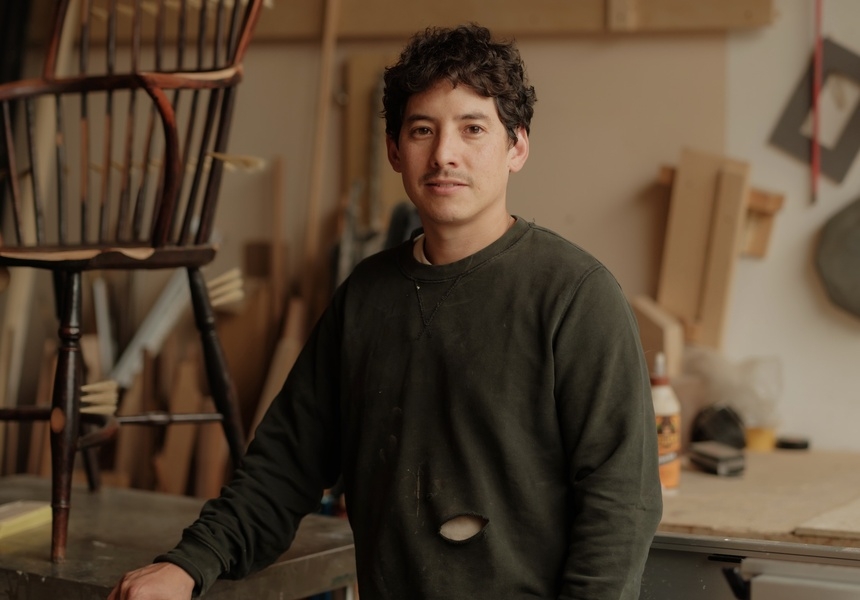

“I’m a woodworker,” says Rio Kobayashi. “Not really a designer.” It’s a self-effacing line, and one that neatly captures both his charm and his paradox. Woodworker, furniture maker, artist, designer – over the past year this east London-based, Japanese Austrian talent has been everywhere: winning at Design Miami’s Best of Show Awards, exhibiting at Frieze London, completing a California residency at JB Blunk Estate, collecting the Emerging Design Medal at the London Design Festival, and preparing new commissions in Tokyo and San Francisco.
Born in 1989 in the pottery town of Mashiko, north of Tokyo, Kobayashi grew up in a country house built by his artist parents. “They used to travel a lot in Europe and India,” he says. “So even though we lived in the middle of nowhere, people were always visiting from all over the world. I never felt bored.” After school, he left Japan to train as a cabinet maker in Austria – “I learned everything from scratch. It was all about precision, about understanding materials through your hands.” He worked in Berlin, Paris and Milan before settling in London almost a decade ago.
“In Innsbruck, I was the Japanese guy doing furniture-making,” he says. “Berlin felt freer, but in London I found anonymity. It feels like being part of the culture – people are considerate, thoughtful and all the cultures melt together.”
Kobayashi’s chairs, tables and shelves often begin with salvaged materials: doors, floorboards, fragments of fireplaces. He combines these with new materials, techniques and finely honed contemporary cabinet-making skills, likening the process to another city. “Kyoto is where old temples and super-modern buildings stand together. It’s that contrast I like – old and new together.”
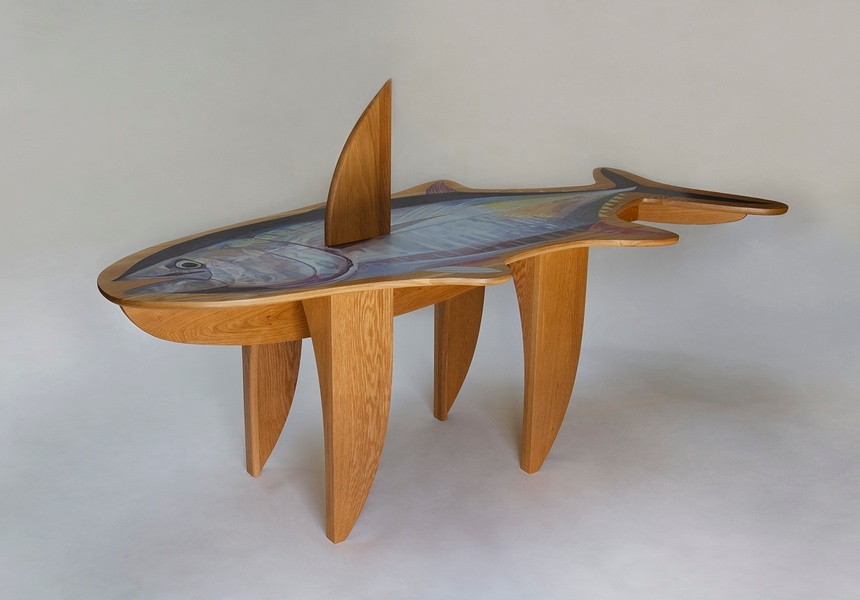
As much as Kobayashi’s approach is grounded in craft, it is also livened with his sense of humour. His 2023 solo show Manus Manum Lavit (“one hand washes the other”) at Cromwell Place was a case in point. Among the highlights was Fatty Tuna, a dining table which makes a four-legged fish, its dorsal fin doubling as a serving board. Piece of Cake, a modular sofa made with designer Flavia Brändle, upholstered in a Peter Pilotto x Christopher de Vos textile was on display in a neighbouring room. “We wanted to be convivial by mixing together,” Kobayashi said.
The exhibition also revisited earlier pieces: lantern-style lamps, kinetic bird mobiles, and Mikado, his first (acclaimed) furniture series inspired by the pick-up-sticks game of the same name. His installation for JB Blunk Space at Design Miami – an entire roomscape assembled from reclaimed wood – won Best Curio and drew art-world attention. Soon after, a chair from a California show with painter Fritz Rauh was acquired by a San Francisco museum. “My friend told me it was way better than DiCaprio buying your work,” he laughs.
His latest show, Crooked Pencils at Kate MacGarry (until December 20), explores “using broken things to build something optimistic”.
There’s been a lot of recognition, but Kobayashi’s focus remains local and grounded. “I have a small team – they’re all so talented, almost over-qualified,” he says. “It makes me grow more.” He also insists, “I’d rather make stuff than talk about it.”
This article originally appeared in issue two of Broadsheet* London's newsletter.*