The Counter is a weekly column from award-winning restaurant writer and broadcaster Jimi Famurewa. Sign up to get The Counter first, sent to your inbox every Wednesday.
Hello there.
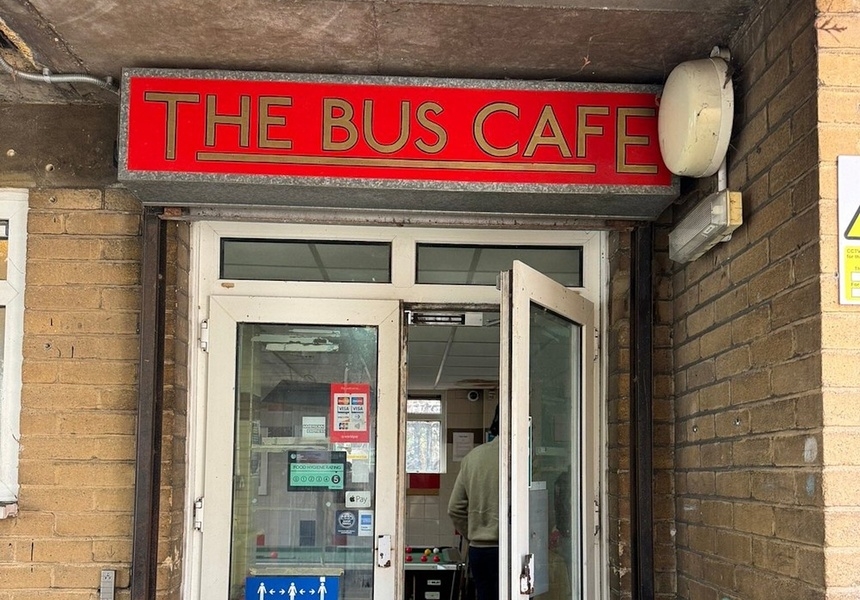
If you happened to see me in Peckham a few weeks ago – wandering the backstreets near Copeland Park, hunched over my phone screen, pacing out confused circles like a malfunctioning Roomba – then you will have probably discerned that I was looking for a restaurant. It’s a very familiar mode and pose. But, on this occasion, I was not trying to find new wave Balkan at Eastern Bloc, inventive Vietnamese at Lai Rai, or some freshly materialised, off-the-radar taqueria riding Pexico's ever-cresting hyperlocal wave. No. I was actually hunting down the entrance to the Peckham Bus Cafe: a clandestine transport canteen and public caff within a bus garage that, thanks to its sheer incongruousness and inexpensive Anglo-Caribbean menu, has become an unlikely, digital age point of pilgrimage.
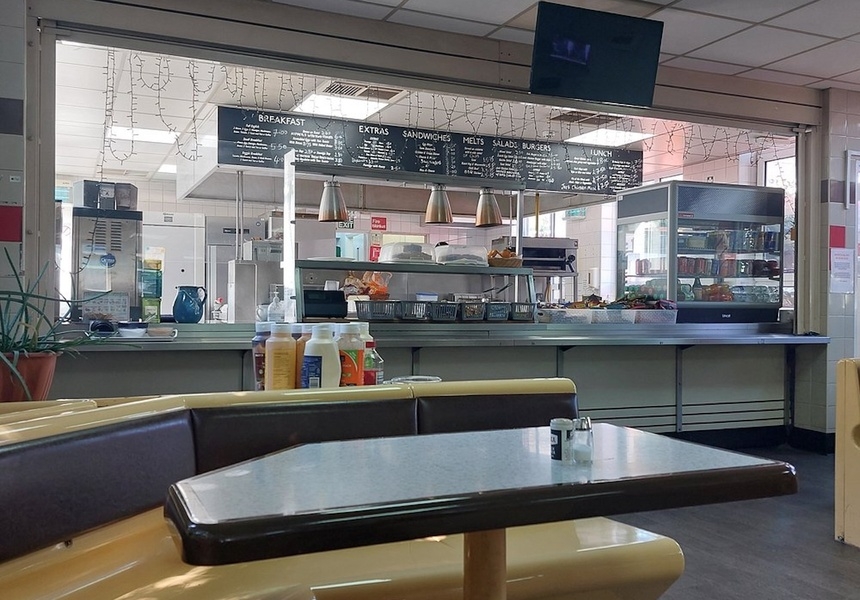
The same can be said of the Bus Cafe in Waterloo: a similarly formulated ceiling tile and scuffed formica wonderland where the anachronistically priced repertoire (think £6 fry-ups, £4 soups and £6.50 jerk chicken plates), presence of a pool table, and pivotal visits from online reviewers like James Dimitri and Dave Eats have bestowed an unexpected virality. Similarly, cabmen’s shelters – those tattered, racing green kiosks that proffer bacon butties, scalding styrofoam cups of Gold Blend and kingsize Twixes to Hackney Carriage drivers and canny locals – have an added cache and Zennial popularity that runs counter to their utility as filling stations for exhausted blue-collar workers.
So what exactly is going on here? Once I’d found the entrance to the Peckham Bus Cafe (an elusive, resolutely sign-free interior door of the sort that Sertaç Dirik and David Carter might possibly approve of), the experience had a quiet, affecting magic. The useless, twirling ceiling fans, snack-festooned serving hatch and burble of Champions League highlights on a lone flat screen. The hi-vis-wearing, off-duty drivers clacking balls across the pool table, napping in corners or shovelling down eggs at one of the grey four-seater canteen tables, seemingly salvaged from a fire-bombed branch of Wimpy. The plate of ackee and saltfish, dense, bulbous dumplings and fried plantain – reheated but rendered with subtle, vivid moreishness and enjoyably redolent of a trinket-filled Caribbean front room – that felt like a hot water bottle for the soul.
The appeal of these spaces, then, extends beyond the honesty of the cooking and the recession-proof nature of the pricing. But their popularity, particularly in the context of modern dining’s ongoing obsession with “hidden gem” culture, tells us something fascinating about both London social history and the shifting contours of appetite. And I think it’s worth digging into exactly what that is.
As ever, it’s useful to explore how we got to this point. Beyond the surface-level world of algorithm-tapping YouTube thumbnails (“A ridiculously cheap Full English in a BUS DEPOT!?”), what are the social forces that created a pair of idiosyncratic, Caribbean fusion canteens in very different parts of south London? The story of the capital’s transport caffs begins in 1933, with the establishing of London Transport as a unified company, and carries on through to a 1950s era when around 87,000 staff were fuelled by food produced in a centralised Croydon kitchen and dished out at 185 canteens.
The cuisine at this time was, by and large, a standard post-war repertoire of English stodge that ran from the perfunctory to the faintly nightmarish: scotch eggs, stewed tripe, steamed puddings, and pre-made sandwiches kept fresh via a tightly packed covering of damp lettuce. By the mid 1950s, a freshly recruited Caribbean workforce began to arrive – it’s estimated that between 1956 and 1970, 6000 staff were hired directly from the islands to take up jobs on buses, trains and in staff canteens – and their presence on both sides of the depot cafe counter had a lasting impact on the food. As with Cypriot- or Italian-run caffs that serve up menemen or lasagne alongside the bacon and bubble, these Windrush-coded greasy spoon menus reflected a kind of naturally occurring fusion cuisine; a time capsule of the blurred British-Caribbean (and, more recently, West African) cultures that have shaped London’s transport network. And a lasting snapshot, even after the early 1990s brought privatisation and the loss of many of the staff canteens, of a bygone cross-cultural age.
This sense of experiencing a glitch in the historical matrix is, I think, a big part of why the bus garage cafes have connected so profoundly. So too is the fact that their deliberately old-fashioned, practically subsidised prices fit both the economic moment and the cultural one, mapping neatly onto an age when the perceived authenticity and timelessness of a historic caff or “old man’s pub” trumps anything needlessly expensive, slop-adjacent or aggressively mood-boarded. But I also think that a big part of the bus depot cafe’s allure is its secrecy. Or rather, the feel that they are like a hidden level in the video game of city life; an exploited loophole where a technicality (both Peckham and Waterloo are seemingly the only two surviving depot canteens that are open to the public) enables access to a space designed specifically for tired service workers.
Is this okay? Subreddits that recommend either of the surviving bus garage cafes tend to soon devolve into an acrimonious debate about gatekeeping, the morality of visiting these caffs as a non-bus driver and hand-wringing speculation about what an imagined army of gawping EatingWithTod followers might do to the atmosphere. Well, if my recent visit to a mostly empty space in Peckham is anything to go by, then whatever virality these spaces enjoyed has dipped to a manageable level, the staff will be glad to see you, and they have an equal opportunities approach to doling out generous Caribbean brunch plates and undrinkably strong cups of instant coffee. We may not all be ravenous 177 drivers heading from Thamesmead to Peckham bus garage. But we will all miss these improbable, unique slices of London history when they’re gone.
For Jimi Famurewa’s dish of the week, sign up to get The Counter first, sent to your inbox every Wednesday.
Got a question about London's dining scene that you'd like Jimi to answer, or a hot tip about a great place to eat or drink in London? Email jimi@broadsheet.com.